How is artificial intelligence being used in journalism now? What's coming next?

 WXXI Connections Studio
WXXI Public Media
280 State Street, Rochester, New York 14614
Program Overview
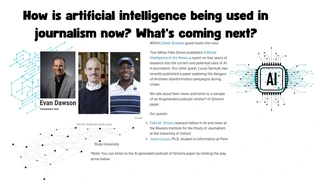
This episode of WXXI’s “Connections” brings together leading researchers to examine artificial intelligence’s transformative impact on journalism and its potential for misuse in disinformation campaigns.
Key Discussion Points
AI in Newsrooms Today
- Content automation and efficiency improvements
- Fact-checking systems and verification tools
- Editorial decision support and audience analytics
- Challenges in implementation across different newsroom sizes
The Disinformation Threat
- Crisis exploitation: How bad actors target vulnerable moments
- Sophisticated generation: Advanced AI creating convincing false content
- Detection challenges: The arms race between generation and detection
- Community impact: Real-world consequences during emergencies
Research Insights
Jason Lucas presents findings on:
- Longtail events: High-impact, resource-limited scenarios where disinformation causes maximum harm
- Detection evasion: How AI-generated content is becoming harder to identify
- Multilingual campaigns: Cross-linguistic disinformation strategies
- Policy implications: Recommendations for media organizations and regulators
Featured Research
The discussion draws from recent academic work including:
- Studies on expert-edited machine-generated outputs and detection challenges
- Analysis of multilingual disinformation campaigns
- Research on longtail impacts of generative AI in crisis situations
Collaborative Perspectives
Felix M. Simon
Research fellow at the Reuters Institute for the Study of Journalism, University of Oxford, sharing insights from “Artificial Intelligence in the News” - a comprehensive four-year study of AI adoption in journalism.
Jason Lucas
Ph.D. student in Informatics at Penn State University, presenting research on AI-driven disinformation tactics and their exploitation during crisis events.
Program Innovation
The show features an AI-generated podcast segment discussing Simon’s research paper, demonstrating both the capabilities and potential concerns around synthetic media in journalism contexts.
Host
David Streever guest hosts this episode, bringing his background in journalism and public media to facilitate this crucial conversation about technology’s role in information integrity.
Listen to the full discussion on WXXI’s “Connections” to hear detailed insights on navigating the complex intersection of artificial intelligence, journalism, and public trust.

I am a PhD candidate in Informatics in the College of IST at Penn State University, where I conduct research at the PIKE Research Lab under the guidance of Dr. Dongwon Lee. I specialize in AI/ML research focused on Information Integrity, Safe and Ethical AI, including combating harmful content across multiple languages and modalities. My research spans low-resource multilingual NLP, generative AI, and adversarial machine learning, with work extending across 79 languages. I have published 12 papers with 260+ citations in premier venues including ACL, EMNLP, IEEE, and NAACL.
My doctoral research focuses on bridging the digital language divide through transfer learning, classification (NLU), generation (NLG), adversarial attacks, and developing end-to-end AI pipelines using RAG and Agentic AI workflows for combating multilingual threats. Drawing from my Grenadian background and knowledge of local Creole languages, I bring a global perspective to AI challenges, working to democratize state-of-the-art AI capabilities for underserved linguistic communities worldwide. My mission is to develop robust multilingual multimodal systems and mitigate evolving security vulnerabilities while enhancing access to human language technology through cutting-edge solutions.
As an NSF LinDiv Fellow, I conduct transdisciplinary research advancing human-AI language interaction for social good. I actively mentor 5+ research interns and teach Applied Generative AI courses. Through industry experience at Lawrence Livermore National Lab, Interaction LLC, and Coalfire, I bridge academic research with practical applications in combating evolving security threats and enhancing global AI accessibility. I see multilingual advances and interdisciplinary collaboration as a competitive advantage, not a communication challenge. Beyond research, I stay active through dance, fitness, martial arts, and community service.