Lightening Talk for the CRA-WP Grad Cohort Workshop for IDEALS
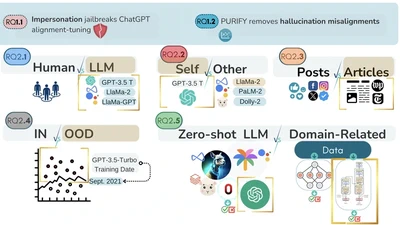
The widespread use and disruptive effects of large language models (LLMs) have led to concerns about their potential misuse, such as generating harmful and misleading content on a …


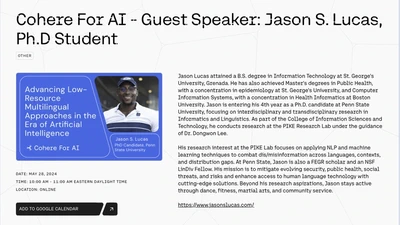
I am a PhD candidate in Informatics in the College of IST at Penn State University, where I conduct research at the PIKE Research Lab under the guidance of Dr. Dongwon Lee. I specialize in AI/ML research focused on Information Integrity, Safe and Ethical AI, including combating harmful content across multiple languages and modalities. My research spans low-resource multilingual NLP, generative AI, and adversarial machine learning, with work extending across 79 languages. I have published 12 papers with 260+ citations in premier venues including ACL, EMNLP, IEEE, and NAACL.
My doctoral research focuses on bridging the digital language divide through transfer learning, classification (NLU), generation (NLG), adversarial attacks, and developing end-to-end AI pipelines using RAG and Agentic AI workflows for combating multilingual threats. Drawing from my Grenadian background and knowledge of local Creole languages, I bring a global perspective to AI challenges, working to democratize state-of-the-art AI capabilities for underserved linguistic communities worldwide. My mission is to develop robust multilingual multimodal systems and mitigate evolving security vulnerabilities while enhancing access to human language technology through cutting-edge solutions.
As an NSF LinDiv Fellow, I conduct transdisciplinary research advancing human-AI language interaction for social good. I actively mentor 5+ research interns and teach Applied Generative AI courses. Through industry experience at Lawrence Livermore National Lab, Interaction LLC, and Coalfire, I bridge academic research with practical applications in combating evolving security threats and enhancing global AI accessibility. I see multilingual advances and interdisciplinary collaboration as a competitive advantage, not a communication challenge. Beyond research, I stay active through dance, fitness, martial arts, and community service.
The widespread use and disruptive effects of large language models (LLMs) have led to concerns about their potential misuse, such as generating harmful and misleading content on a …
In this talk we present research that tackles the misuse of large language models (LLMs) by introducing the Fighting Fire with Fire (F3) strategy, which uses GPT-3.5-turbo to …
Served as reviewer for top-tier NLP conferences including ACL, EACL, and EMNLP (2024–2025).
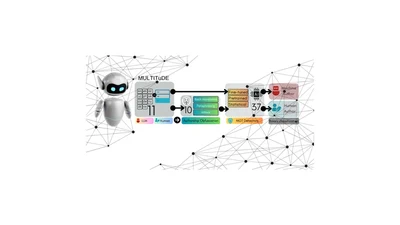
This research from Penn State and KiNiT, benchmarks the effectiveness of 10 authorship obfuscation (AO) techniques against 37 machine-generated text (MGT) detection methods across …
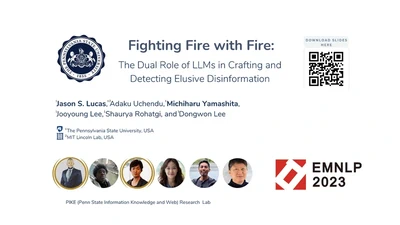
Michiharu Yamashita and I co-present our latest research, Titled, Fighting Fire With Fire - The Dual Role of Large Language Models in Crafting and Detecting Elusive Disinformation. …

This research from Penn State and KiNiT introduces MULTITuDE, a novel multilingual dataset for detecting machine-generated text. Comprised of over 74,000 authentic and …
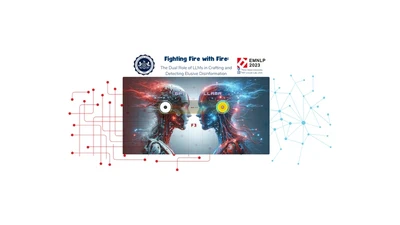
This research project is a collaboration with Penn State and MIT Lincoln Lab. Our study demonstrates the dual capacity of LLMs for offensive misuse and defense detection against …
This talk explores recent advances in AI and natural language processing. It highlights an influential EMNLP 2023 paper: “Fighting Fire with Fire” - introducing adversarial attack …
I co-presented with Cristal Giorio Jackson at the 2023 NSF NRT Annual Meeting in Arizona State University. This NSF-funded research examines whether mismatching native accent …
This presentation at the "Research in Action" alumni program was delivered alongside Dr. Carol Miller and Suhas Nagaraj and focused on leveraging AI in speech and language therapy …